This is a blog with information for consumers with hearing loss, hearing aid and CI users and hearing loop advocates.
Hearing loops broadcast sound from a sound source wirelessly to hearing aids. All a user needs to do is switch a hearing aid to the telecoil or Mic + telecoil mode. Hearing loops provide phenomenal hearing in situations where poor acoustics, reduced word discrimination and auditory processing problems would have made understanding nearly impossible. For sound demos out vs. in a hearing loops – Listen here
If you would like to learn more about bringing hearing loops to your community feel free to contact me via jsterkens@hearingloss.org or post questions and remarks. The goal of this blog is to inform and bring those interested together to help loop one community at a time.
Juliette Sterkens, AuD – Audiologist
HLAA National Hearing Loop Advocate
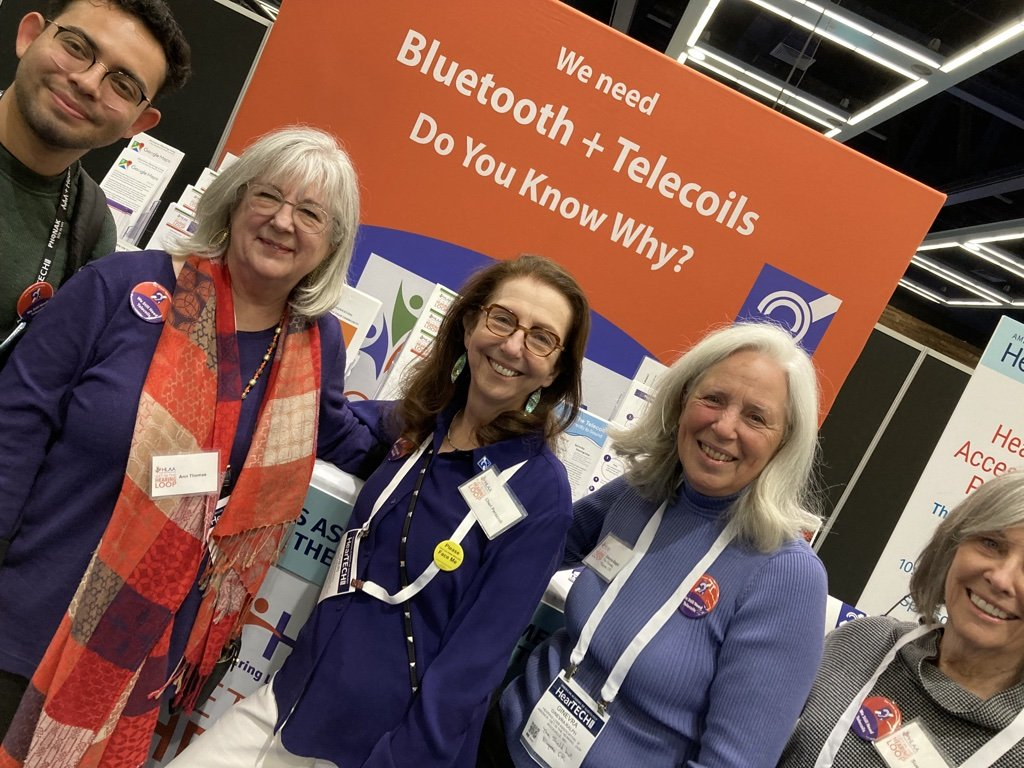
These advocates know why: Ask Ann Thomas, Cheri Perazzoli, Ginevra Ralph and Sue Pritchard.
Hearing loops in venues and telecoils in hearing aids: Today, this combination is still the gold standard for hearing accessibility the world over. In fact, hearing loops are so beloved that they inspired local and even national movements like HLAA’s Get in the Hearing Loop and even Loop Washington, which was founded by our HLAA-WA President Cheri Perazzoli.
You’ll hear a lot about new Bluetooth technologies like Auracast, and while these technologies are promising, they’re not yet ready for prime time. Auracast will co-exist with hearing loops and telecoils for years. That means we need audiologists to help us use all the technologies available to us — including telecoils — for the foreseeable future.
Audiologists juggle a lot of priorities during a patient’s visit, and it can be easy to forget to talk to patients about telecoils in their hearing aids. Armed with the knowledge of telecoils and the know-how to use them in public spaces, however, patients can truly make the most of their hearing devices. Which means they can live, work, play, and travel more safely and confidently.
We often say, “People with hearing loss want to hear wherever they go.” Ann Thomas from HLAA-Diablo Valley adds, “People with hearing loss live uncertain lives.” Hearing loops, telecoils, and Bluetooth reduce that uncertainty and empower people with hearing loss to communicate in more places.
That was our message as we connected with audiologists at the American Academy of Audiology conference (HearTECH Expo) April 19-22, 2023, at the Convention Center in Seattle.
A huge THANK YOU to the American Academy of Audiology and the terrific audiologists who welcomed us to their conference and provided a complimentary booth for us in the accessibility pavilion.
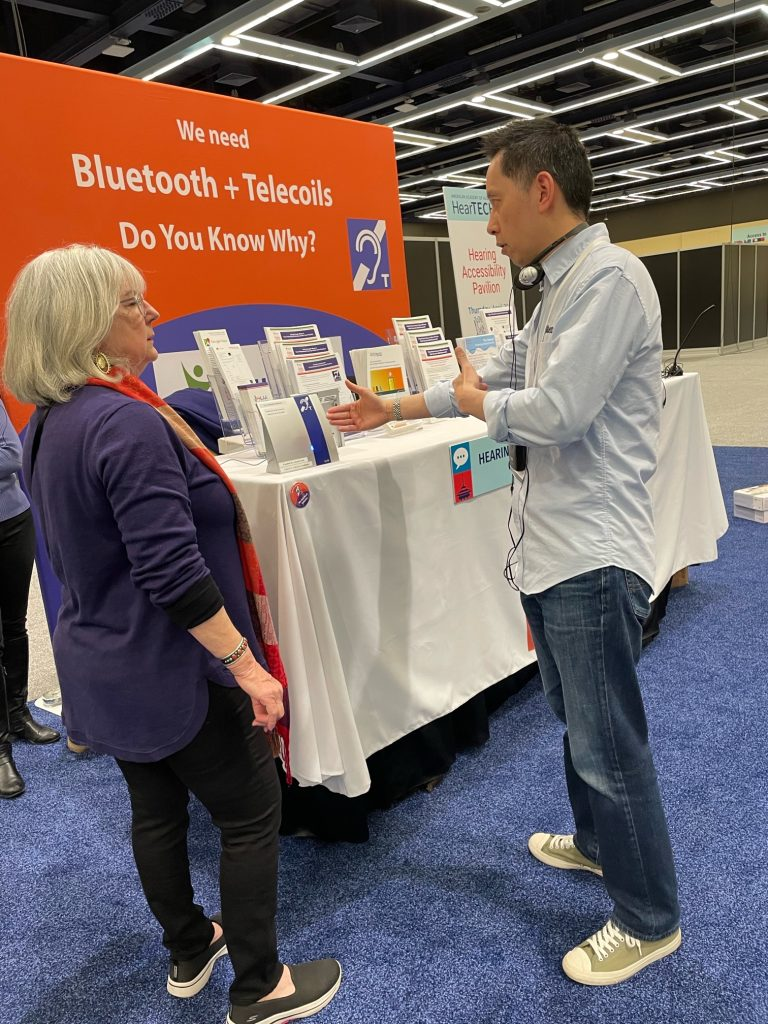
Ann Thomas talks with Henry Wong at the American Academy of Audiology conference in April 2023 in Seattle, Washington.
While Bluetooth LE Audio solutions like Auracast may be coming, telecoils and hearing loop systems remain the proven and existing assistive systems for hearing aid users—today.
Originally published 08 August 2022 as a letter to Karl Strom, editor of Hearing Tracker.
By Juliëtte Sterkens, AuD
As an audiologist with over 40 years of experience, I have published numerous articles on the effectiveness and popularity of telecoil-enabled hearing aids and hearing loop systems that make them so valuable to consumers with hearing loss, particularly in public venue applications. More recent media attention has highlighted the development of new Bluetooth technologies, like Auracast, with a veiled implication that the venerable magnetic induction hearing loop systems are on the road to obsolescence.
A recent HearingTracker article by Linda Kozma-Spytek, Trends in Audio Streaming for Hearing Aids and Hearing Aid Compatibility for Wireless Phones provides a good overview of employment of wireless technologies in hearing aids. Drawn from 10 years of HearingTracker data, it suggests more than half (54%) of new hearing aids purchased contain telecoils, while 4 in 5 (80%) contain some form of Bluetooth technology.
However, this could lead readers to jump to some mistaken conclusions. It is important that hearing care professionals, consumers and members of the Hearing Aid Compatibility Task Force understand that while Bluetooth LE broadcast audio systems like Auracast show great promise for telephone compatibility and eventually for public assistive listening systems – the when, where, and how of this promise is yet to be delivered or determined.
Desktop portable hearing loop displaying the international signfor availability of telecoil listening. (External mics improve signal-to-noise ratios for table top loops.)
While the industry develops, tests, and ultimately deploys exciting new broadcast audio technologies, it is critical that hearing aid consumers continue to reap the benefits of hearing aids with proven telecoil technology to connect to telephones AND existing assistive listening systems TODAY.
In my view, misconceptions about connectivity include:
That every user who has Bluetooth (BT) Connectivity in their hearing instruments actually uses it as their preferred way to couple to the telephone. In actuality, there are many public comments posted in Facebook groups by overwhelmed consumers who complain about their inability to pair, re-pair, or to keep iPhone or Android devices paired to their hearing aids. Additionally, not every hearing aid user owns a mobile phone, and older persons may struggle with new technology.
That consumers specifically opted out of purchasing hearing aids with telecoilsfor some unexplained reason(s). In fact, there are many factors that contribute to people not getting telecoils in their hearing instruments, including: a) Their provider didn’t understand or downplayed the benefits of telecoils in favor of BT coupling and rechargeable batteries; b) the brand sold by their provider did not offer a model that included both rechargeability AND telecoils, or c) they were never told about telecoils in the first place. New HLAA chapter members report rarely being educated about the benefits of telecoils or given a demonstration by their provider.
That consumers do not want telecoils built into their hearing aids. In reality 1 in 3 consumers wanted the ability to access audio broadcasted by hearing loops as shown by another survey by HearingTracker (2018/19) that detailed the hearing aid feature preferences of nearly 15,000 consumers.
Lecture halls, theaters, and other large-area venues where hearing can be difficult due to distance and reverberationare greatly aided by hearing loop systems for users of telecoil-enabled hearing aids and cochlear implants.
Existing universal system
Beyond connecting to a number of existing telephone models, telecoils connect to assistive listening systems that are in use the world over, the value of using telecoils are many:
They do not affect the power consumption of the instrument;
They come at very low or no cost to the user, and
They deliver sound without audible latency, and are very easy to use.
The Americans with Disabilities Act (ADA) requires venues to provide hearing aid compatible assistive listening systems where there is audio amplification, such as government and civic venues, theaters, airports, and train stations, classrooms, etc. Existing ADA-compatible systems are hearing loop, FM, and IR systems—and each of these systems, in different ways, use telecoils to connect audio signals to a person’s hearing aid.
Hearing loops are the gold standard for assistive listening systems because they provide simplicity, immediacy, and reliability. Since 2012, I have worked for the Hearing Loss Association of America (HLAA) and its thousands of members with hearing loss as the National Hearing Loop Advocate. I have personally experienced the benefits hearing loops (that meet the IEC 60118-4 standard) in hundreds of venues and I have witnessed the joy and benefits loops provide its users and venues across the world. To connect to hearing loops directly, all users need is simple access to a telecoil inside their hearing device.
Market trends indicating greater telecoil and hearing loop use
The recent article by Kozma-Spytek might lead some readers to conclude that the number of telecoil-equipped hearing aids will continue to dwindle. However, multiple market trends indicate the opposite reality.
Industry:
“Superfecta” model hearing aids are increasingly being offered by the big 6 hearing aid manufacturers. Superfecta hearing aids are defined as having these four essential features: rechargeability, extremely small form factor, direct streaming to smartphone, and telecoil.
Google Maps has recently begun adding hearing loops—alongside wheelchair access—as an accessibility attribute within Google Maps business profiles.
The telecoil feature has been more prominently featured in hearing device advertising by manufacturers to hearing care professionals.
Hearing aid manufacturers have developed accessories that permit direct streaming of telecoil signals permitting retroactive hearing aid compatibility to magnetic inputs.
Hearing Loops:
Hearing loops are gaining momentum worldwide, with installations at more and more varied venues including worship places, auditoriums, transportation hubs, and even train cars, taxi cabs and subway stations.
Professional and Consumer Outreach:
Telecoils have increasingly been the topic of professional continuing education in the form of web-based articles, podcasts, CEU and professional lectures.
Well-known consumer hearing aid information websites, such as HearingTracker, Hearing Aid Know and Healthy Hearing, regularly discuss telecoils. YouTube influencer Dr. Cliff Olson who campaigns for Best Hearing Care Practices and consumer satisfaction frequently highlights telecoils.
Bluetooth LE timing and availability
Auracast Bluetooth LE-Audio is currently being hailed as a technology that will allow consumers to receive audio signals via their BT-enabled hearing aids from public address systems. That suggestion may be a little premature as no large-area Auracast transmitters have been developed, built, or installed yet.
While this technology appears promising, no in-depth testing with experienced users of hearing aids and/or cochlear implants has been started—as no Auracast compatible hearing aid devices are yet on the market. Recognized experts in this area, such as Nick Hunn and Peter Mapp, as well as Chuck Sabin from the BT SIG group, have all indicated that telecoils and BT-LE audio will co-exist in a duo-ecosystem for many years. Furthermore, multiple people mention a transition time for Auracast to be universally available of 5 to 10 years.
People with hearing loss need to hear now, and telecoils and hearing loops remain the best and simplest solution for the foreseeable future.Consumers will need access to both telecoils and Auracast for many years to come.
As we all know, hearing loops are old technology. So is the wheel. For years, we’ve been told that personal jet-packs and flying cars are just around the corner. And for about the same amount of time, we’ve been told that reliable Bluetooth broadcasting is just around the corner to create a new standard for assistive listening. Have you seen either? I’m still waiting… Are we halting the manufacturing of wheels today because 5 or 10 years into the future, magnetic levitation might challenge the status quo? Then why are we skeptical about integrating the only globally universal open standard for hearing access that coincidentally offers the highest level of convenience for the user, virtually non-existent latency, and extremely low power consumption? Hearing loops are needed and viable more than ever before.
“Hearing loop technology isn’t perfect,” you might say. Well, are hearing aids? How else can you achieve an increased signal-to-noise ratio of sometimes more than 20 dB? Not with noise reduction algorithms. Not with directional microphones. As Marshall Chasin wrote a few years ago, “Killion had it all figured out in 1988.” (https://bit.ly/2r7mPpm) And he’s absolutely right. A lot of us have been frustrated with the lack of recent innovation in the hearing aid industry. While the ultimate goal should be to improve an individual’s hearing ability, particularly to hear clearly in noise, we now see smart home connectivity, usage tracking and behavioural analysis, smartphone apps, remote care, and rechargeable batteries touted as revolutionary features. When you study Mead Killion’s K-AMP paper from 1993 (https://bit.ly/2ShY4CE) – and if you’ve never looked at it before, I strongly encourage you to read the whole thing – it becomes rather obvious why the industry seems to have hit a ceiling. We have physics working against us.
Nobody’s Perfect. But We Can Get Pretty Close…
There are exactly two routes to a dramatically increased signal-to-noise ratio when trying to separate the voice of one talker (signal) from the voices of multiple other talkers (noise that looks like signal). The first route is to leverage artificial intelligence and identify each individual talker to then separate their voices in real-time. In essence, this is what IBM Watson launched for their speech-to-text platform less than two years ago (https://ibm.co/2TPzOt9) and of course, it doesn’t work for people speaking simultaneously (yet). The second route is to improve microphone placement. Most of us are familiar with ReSound’s Microphone-in-Helix. Fewer of us are familiar with ExSilent’s “MaRiC” approach (https://bit.ly/2Shqehc), where both the microphone and the receiver are placed inside the ear canal. But you’re thinking inside the “hearing aid box” again… If you explained to any live sound engineer what the hearing aid industry has been trying to accomplish, they’d just be shaking their heads. They will all tell you that the microphone belongs close to the sound source, not on top of an ear 30 foot or more away from what you’re trying to hear. Remote microphones are a step in the right direction, but how about we all share the much better microphones that the presenters or musicians on stage are already using?
Back to “hearing loop technology isn’t perfect.” The common criticisms and limitations of hearing loop technology are (1) cross-talk between systems in adjacent spaces, such as movie theatres, (2) electromagnetic interference (EMI) from electrical mains wiring, and (3) sensitivity to the direction of the pickup coil. The first issue can easily be solved by designing a low-spill array or by employing cancellation loops (https://bit.ly/2zss8o9). The EMI issue has been solved very elegantly by Steve Julstrom even in the analog domain (http://bit.ly/2Q3d4I0). And the third issue is easily overcome by utilizing a tri-axial telecoil pickup as proposed by Tim Riehle (http://bit.ly/2P3OX6r).
[[[Footnote: Of course, I am fully aware that it is essentially impossible to convince any hearing aid manufacturer to free up the required physical space and to dedicate 3 ADC channels to telecoils, but if you want to do all of us a huge favour, try to convince the manufacturers to at least implement a decent hum filter. It doesn’t require much processing capacity but makes a significant difference for the consumer.]]]
Now contrast that with the challenges of other technologies conceivable for assistive listening: Connectivity issues, audio latency and drop-outs, and most importantly, the lack of universal compatibility with hearing aids and cochlear implants across all manufacturers. We get to pick between a poor listening experience that’s easy for the venue to implement or an exceptional listening experience that requires a little bit of engineering skill. Which would you prefer?
Thinking Outside the Box
I’d like you to think completely outside of the “hearing aid box” for a minute. Think of a live concert. Think of the artists on stage. How do they hear their mix? In 1987, Stevie Wonder became the first musician to ever perform using wireless in-ear-monitors. It allowed him to move around the stage freely, adjust the volume to his liking without any impact of extraneous noises, and most importantly – and this is not a joke – his sound engineer could speak to him directly and make sure Stevie wouldn’t fall off the stage.
Let’s take a step back and think of your listening experience at the same show, say in an arena with 20,000 people in the audience, and contrast that with listening to a vinyl record with high-end headphones at home. You can’t even compare the two. So, why aren’t we bringing wireless in-ear-monitoring to the audience? Rather than being isolated with headphones in your home, we could make high-fidelity music listening a shared experience. With hearing loop technology and what we call “hearing aids” we can do exactly that. Whether it’s an open-fit RIC or a custom ITE, all that matters is that it has a telecoil. Add a smartphone app with user-customizable microphone/t-coil mix, volume control, equalization, and enough reserve gain to combat the 110 dB SPL from the loudspeakers (which hopefully we’ll be able to eliminate in the long run), and you have a winning combo.
Music to my Ears
Fast forward to 2018 and the world of Dolby Atmos (http://bit.ly/2PXP4pj). With this new object-based audio format, we can explode sound into the space around you. Each individual audio source has spatial coordinates attached to it and can be rendered out for your specific room and loudspeaker setup or headphones. Dolby Atmos for Music is now available in a select few night clubs and DJs produce music that is literally flying around the audience. Last year, the Beatles album “Sgt. Pepper’s Lonely Hearts Club Band” was released with a new Dolby Atmos mix and you can get a sense of what it’s like here (http://bit.ly/2rgDgQB). Listen to it with headphones and pay attention to every nuance you can hear in the 6-minute clip. Then think of this quote from one of our happy hearing loop users: “I literally couldn’t believe my ears. I heard David Crosby’s pick against the guitar strings, his swallowing before the next verse. The depth of the sound was truly overwhelming.”
What’s Next?
You think hearing loops are dead? I think they’re just reaching puberty. The installation base is growing rapidly where users are advocating for the technology and we’re seeing more and more “non-traditional” applications that aren’t just limited to speech. What are the problems we have yet to solve? First, the lack of stereo capability, which isn’t all that difficult to do. It just hasn’t been a priority for anyone. Second, we need to get people to understand that hearing loops aren’t just for those with hearing disabilities. They are for everyone. We have a much greater need to change perceptions and attitudes than to change technology. We already have the right tools. We just need to use them properly.
We have an opportunity to bring a dramatically improved signal-to-noise ratio to any attendee of a theatre play, worship, a lecture, a professional conference, or a rock concert in a much healthier and fully customizable way. We can go beyond stereo sound and create fully immersive listening experiences. We can let people hear sound the way it was meant to be heard, sound that is true to our ears. But we are dramatically underutilizing the technology we have available today; a technology that has the potential to completely transform the way all of us experience sound in our daily lives.
You may say I’m a dreamer, but I’m not the only one…
With heartfelt thanks to Thomas Kaufmann for allowing me to reprint this article on my LoopWisconsin blog.
Thomas Kaufmann is a disability advocate, entrepreneur, meditator, lateral thinker, inventor, foodie, traveler and founder of OTOjOY.
A couple of years ago I attended the showing of a movie “the Hundred Foot Journey” in a small hearing looped community theater – (if you have not seen this movie, I can highly recommend it) with three friends and my husband. As an ESL – English as a Second Language person – I struggle understanding dialogue through the music, sound effects, and background noise. I have stopped attending movie theaters. I wait until I can order the DVD from Netflix. At home I turn on the captions and do not have to struggle and get to enjoy and understand movies with ease.
I had previously seen the “The 100 Foot Journey” and, as I often do with movies I enjoyed, I was looking forward to seeing it again. A hearing loop announcement was made by one friend whose foundation helped fund the loop, and we settled into our chairs with our popcorn.
As soon as the movie started, I realized the captions were not on. This upset me; I knew one of my friends has limited speech discrimination. I turned to my husband – who motioned a “don’t bother, honey.” I knew the movie involved actors with Indian and French accents, which would not only make hearing difficult (hearing loop or no hearing loop) for my friends who use hearing aids and/or implants, but it would also make it difficult for me to enjoy the movie.
So, I got up and pleaded with the pop-corn lady to turn the captions on– my request was dismissed with a terse “No. Our patrons do not like to see captions!” But when I insisted, explaining that several persons in the theater would not be able to enjoy the movie without them, she recommended I talk to the community theater director in his office. He didn’t think their equipment had that capability but suggested I talk to the volunteer in the theater control room. “Captions? I have never seen them in use here!” he protested when I asked about activating them. He pointed to the remote control for the DVD player on his desk. I spotted the “CC” button on the device right away – pushed it, and instantly the captions appeared on the white screen. Success! Upon returning to my seat, I got two thumbs up from each of my friends and once again settled in my chair, to enjoy the movie.
The best part? When we were leaving the movie theater, I overheard someone say that they really enjoyed the captions because people with accents are so difficult to hear! Ha! I felt vindicated.
Why aren’t more films screened with open captions? Shari Eberts recently wrote a blog about a group of advocates in New York City is trying to achieve just that. This group supports a city ordinance that would boost the required number of open captioned screenings at local cinemas. Their aim: more equal access at the movies for people with hearing loss. I singed it as I personally would much rather see block-buster movies in the theater with many others. Read Shari’s blog below and don’t forget to sign the captioning petition https://www.change.org/p/open-captions-subtitles-are-healthier-for-everyone
Hearing loss advocates in Seattle WA were able to pass a bill that requires televisions in all of the city’s public spaces to show closed captioning whenever those TVs are on. This includes bars, restaurants, fitness centers, and hospital waiting rooms. Albuquerque, NM recently passed similar legislation. Maybe, bills like this will get folks used to seeing open captions on TV. Perhaps getting to open captions acceptance is a journey. Plus, the Boomers are aging fast and with age comes a change in hearing. Perhaps that too will lead them to request open captions shows in movie theaters. I too would like that.
(To find out what horse racing has to do with hearing aids, listen to Dr. Brian Taylor’s podcast)
People purchase hearing aids because they want to hear in situations that are important to them. It is easy to reason that the more situations the devices improve the person’s ability to hear, the happier the owners of those devices are going to be.
Sergei Kochkin (2010) has researched hearing aid satisfaction in detail. He documented that consumer are much more satisfied with their hearing aids when they have high multiple environmental listening utility (MELU) with their devices. Higher scores were obtained in users who reported increased hearing aid utility. Participants in his study were asked to rate their satisfaction with hearing aids in 19 typical listening situations. He used a 7-point Likert scale which ranged from “very dissatisfied”, “dissatisfied”, “somewhat dissatisfied”, “neutral”, “somewhat satisfied”, “satisfied” to “very satisfied”. The patient’s MELU rating is the percent of listening situations in which hearing aid users were “satisfied” or “very satisfied.” Kochkin documented that the “somewhat satisfied” scores (see in the image below) did not contribute to overall hearing aid handicap improvement scores and therefore should not be included in overall hearing aid satisfaction. The highest satisfaction levels with hearing aids were obtained in one-on-one communication (76%), followed by small groups, TV, listening while riding in a car, and listening to music, all in the 60% range, hearing in places of worship scored 58%, and scores for hearing in large groups, classroom or workplace are closer to 50% satisfaction or less. (See figure 1)
A Consumer Reports’ survey of 12,000 users (published in May 2019) pooled consumers’ experiences in 8 situations (conversation in quiet places, conversation in noisy places, talking in small groups, Listening to a TV or radio, talking on a cell phone, talking on a landline phone, at the movie theater, play or concert and windy conditions) – the average satisfaction (where 100% meant satisfied in every condition) was in the 70% range with significantly better scores in quiet (as shown by dark green and light green circles), neutral scores for far-field listening situations and on the phone (shown in yellow), and generally poor scores (in orange and red) in noisy and windy environments.
These survey results demonstrate that hearing aids can do a good job for near-field and quieter situations, but they are not able to handle the users’ communication needs in background of noise and in far-field situations. For many users this is due the nature and severity of their hearing loss, and the fact that they need signal-to-noise ratios that hearing aids – when used in situations beyond 3-6 feet – are simply unable to provide.
What if there is a way to dramatically improve audibility or signal-to-noise ratios in situations that are important to consumers? (Think weekly attendance at religious services or attending lectures or an occasional theater performances.) A solution that not only helps consumers hear, but will also improve the overall hearing aid satisfaction. Something, Dr. Kochkin surmised in a 20Q interview with Dr. Gus Mueller for AudiologyOnline, would benefit the hearing industry as a whole. Such as solution exists today. But this solution, permanently installed hearing loops (as well as other assistive technology equipped with neckloops – as mandated by the Americans with Disabilities Act) can only be accessed, and benefit users, if the hearing devices are equipped with telecoils.
Good News! For the last couple of years, consumers and their providers have had to choose between hearing aids that offered telecoils or wireless connectivity, or hearing aids that included rechargeable batteries but no telecoil. When consumers demanded small cosmetically appealing rechargeable hearing aids the options for a device that included a telecoil were slim to none. No longer – Enter the Superfecta hearing aid.
Superfecta devices no longer require providers to compromise in selecting useful features for clients. These devices have it all – and as such, just might increase hearing aid satisfaction, but only when the benefits of the telecoil are discussed and demonstrated, clients are referred to hearing loop (or neckloop) equipped venues following the fitting, and even better yet, if their hearing care providers become active hearing loop advocates by sharing HLAA’s Get in the Hearing Loop Advocacy materials.
Listen to the AudiologyOnline podcast where Drs. Brian Taylor and Juliëtte Sterkens go into detail on the four essential hearing aid features (rechargeability, small form factor, direct streaming to smartphone and a telecoil), how such devices will expand the multiple environmental listening utility (MELU), tips on programming, verifying and validating of telecoils, hearing loop advocacy, and why everyone ought to place their bets on superfecta hearing aids.
To say it in advance: The classic induction (hearing) loop is still the clear choice. And that will probably remain the case for the next 10-20 years.
In January 2020, after 7 years of planning and discussion at the instigation of EHIMA (European Hearing Instrument Manufacturers Association), an extension to the Bluetooth Low Energy standard was finally decided: Bluetooth Low Energy Audio (short: BLE Audio).
Previous versions were either not able to transmit audio at all, or if so, only with expensive hearing aids and usually only with proprietary technology from Apple compatible only with newer iPhones. So far, however, only a limited number of devices (max. 2 hearing aids in parallel) can be connected. As a public assistive listening system it is therefore not suitable. That has changed with the new BLE Audio standard, at least in theory. Only the future will show whether this can be achieved in practice. It depends on very different factors, such as the acceptance of the hard of hearing people, the usability and, last but not least, whether it can succeed in ensuring a stable transmission network.
One thing is certain, BLE Audio will appear in the first hearing aids in 1-2 years at the earliest. So far, it has not been installed in any hearing aid. It will also not be possible to issue a software upgrade for already existing hearing aids, as the physical hardware would not be compatible. Some hearing aid manufacturers now have to redesign, reprogram, produce and, above all, re-approve their hearing aid chips worldwide. That alone will consume time and money. Therefore, it is very likely that the most expensive hearing aids will be equipped first, then the medium-priced hearing aids, and only after a considerable delay will the basic devices also be equipped with BLE Audio functionality, as we have seen with other innovations in hearing aids.
So, it will take at least several years, until (perhaps) most new hearing aids will have BLE audio. However, not all people will have hearing aids with this technology by then. Hearing aids in Germany usually have to be worn for 6 years. Most people who have to make a co-payment however, wear their devices significantly longer. This means that we can expect comprehensive coverage with BLE Audio at the earliest 10 years after the sale of the last hearing aids without BLE Audio. These periods are mostly underestimated, as not all people are supplied with high-end devices or have the money for new ones. Especially people aged 80 and over often no longer buy new hearing aids “because it doesn’t pay off for me”.
Induction loops will not “die” that quickly. They are still the most reliable, cost-effective and low-maintenance hearing system available to us. They are also the only public assistive listening technology that are barrier-free and will remain so, at least for the next 2-3 generations of hearing impaired people! This is why the International Hearing Access Committee (IHAC) assumes a time window of at least 10-15 years or even more. (https://www.ampetronic.com/2019/08/hearing-loops-and-telecoils-could-they-be-replaced-soon/)
After that, induction loops and BLE audio (or other successor standards) could coexist, and maybe it will stay that way for a very, very long time. It is not yet clear whether this will not even become the norm. We recently spoke to the Technical development manager of a hearing aid company. He strongly believes that for hearing aids which only have BLE audio (instead of telecoil), there will be additional external devices for inductive reception.
Perhaps inductive hearing aids will eventually be replaced by this or another technology, but one thing is certain, BLE Audio will not be an option for the next generation of hearing-impaired people. Most of them will not be able to use it and will therefore be dependent on a different solution. Also, as a rule, the inductive hearing system (installed above ground) continues to be the basic technology for primary care. The telecoil will not disappear, despite gloomy predictions, because it will remain necessary for those countries, where a comprehensive supply of the latest smartphones is not economically viable.
But what use does the new Bluetooth 5.2 (BLE Audio) from January 6, 2020 have?
What could the previous Bluetooth versions in hearing aids achieve?
Bluetooth Classic (BTC) is only available in very few hearing aids because actually it does not make sense. Although it can transmit audio, it consumes a lot of energy, battery-wise, and has a high latency (time between the spoken and heard word) and is therefore not able to lip-sync.
Bluetooth Low Energy (BLE), also called BT Smart, has no audio transmission, so it is only used in Hearing aids for remote control.
Bluetooth Low Energy (BLE) with Apple extension (“made for iPhone”) can transmit audio, but only with newer Apple devices, all other smartphones, notebooks and tablets need an additional device, subject to additional charge. There may also be problems with the latency here.
Pairing:
In all three versions, the hearing aid must be registered on the transmitter (the smartphone) i.e. the hearing aid must be individually paired with the transmitter. Before BT 5.0 only one audio pairing per transmitter was available. From BT 5.0 on a maximum of two audio receivers could be paired at the same time (e.g. a Bluetooth speaker and a hearing aid), not more.
These are the main reasons why Bluetooth up to version 5.1 is not suitable for a public hearing system
no audio or only with a special additional device
high latency
pairing
only two participants maximum
What’s new with BLE audio?
Bluetooth-Low-Energy 5.2 is now able to transmit audio, like previously the Bluetooth Classic. BLE 5.2 got a brand new CODEC (“LC3”) that shrinks the audio data, as with MP3, so that parts of the language are not transmitted. This reduces the latency to around 5ms. It will only be clear towards the end of 2020 how exactly this will work.
Bluetooth Low Energy 5.2 now offers a “streaming” solution. In addition, each audio data packet comes with a period of validity. If it cannot be sent during this period (e.g. due to overloading of the Bluetooth chip or network, or not processed by the hearing aid) it will just be left out. This results in dropouts, crackles and wrong sound in the hearing aid speakers.
Bluetooth-Low-Energy 5.2 now also has multi-streaming. One transmitter can have multiple audio streams sent simultaneously i.e. in a conference hall or cinema for translations e.g. German and English. The hearing aid can also subscribe to multiple streams e.g. a soccer game broadcast in a pub and the announcements of the host or an alarm system.
In addition to the normal pairing between the Bluetooth transmitter and the hearing aid, there is now also the so-called Broadcasting, i.e. a kind of radio. The hearing aid no longer has to be registered or paired with the transmitter but just ‘listens’. There are different types:
completely free listening
listening with approval (= passcode). Since Bluetooth radio goes through walls, too, this prevents someone from listening in on a park bench outside the venue.
With Bluetooth Low Energy 5.2, the hearing aid can automatically connect to a nearby hearing station (e.g. an exhibit in a museum). Additional aids or devices are not required. Although, the hearing aid must be switched to the correct mode beforehand.
So far only the basic plan (core specification) has been adopted, more than 20 necessary detailed features are expected to come later in the year. The first chipsets are expected to be available in a year.[1]
However, all of these new functions are not mandatory for a Bluetooth chip to be recognised as version 5.2, manufacturers are also allowed to install only parts of the standard. That means, even if a new notebook has a Bluetooth 5.2 chip installed, it is far from being said that this PC is suitable for use as a public hearing system. What functions in real hardware, in firmware (programs on the chip), what is in the driver, in the operating system or buried in the application software is not clearly recognizable. BLE audio will also not be available on Android below version 10, so an upgrade to a new device is mandatory for those with older models.
We could not find any information on Apple, although Windows 10 will receive an update at some point. Probably the new chips will be at first installed in the expensive smartphones / tablets / PCs and only afterwards with several years delay on the affordable mid-range devices.
Compatibility with previous devices:
All expensive hearing aids “made for iPhone” will not work with BLE Audio, unless a hearing aid manufacturer would develop a BLE Audio accessory “made-for-iPhone” and a corresponding app that controls the device. Bluetooth Classic devices could not pair either. It cannot be assumed that hearing aid manufacturers will develop new software for previous Bluetooth hearing aids, create a new driver and replace hardware parts. For each “made for iPhone” hearing aid there already exists an adaptor for Bluetooth classic. Now theoretically it could be possible, that a third-party manufacturer develops an additional adaptor translating BLE audio to Bluetooth classic. And these two devices have to be coupled. However, if that should be the case there would be a long latency period between the sound being generated and it being heard, e.g. in a thriller film a victim would fall over before the gun shot would be heard.
But what options will be available hearing aid users that currently use a telecoil ? Currently devices are available for a few Euros which receive Bluetooth Version 4.2 and output on a headphone jack to allow all wired headphones to receive Bluetooth audio. A hearing aid user can use the same device to drive a neck loop. Given that such a device will be required for the much larger headphone market, it is likely that a “Bluetooth 5.2 receiver” will be readily available.
Handling:
With a BLE audio hearing system, the hearing aid must be paired to the desired audio stream to receive it. The one to four buttons currently used on hearing systems almost certainly won’t be adequate, especially with content requiring approval; the passcode can hardly be entered on the hearing aid manually. Therefore, it is very likely that a smartphone will always be necessary to control hearing aid technology using this standard. Difficulties arise ensuring all those people who experience hearing loss have a current smartphone. That again takes time, for example even Bluetooth 5.0, launched in December 2016, is not even present in all current early 2020 smartphones.
“Coupling” to public hearing systems
Anyone who has ever tried to pair their Bluetooth speaker with their smartphone knows that this is not always easy. A hearing aid with Bluetooth 5.2 standard has to connect with a Bluetooth hearing system transmitter in a church, the parish hall or in public spaces. That this connection will most likely not be done on the hearing aid itself makes things more problematic and complicated, not easier. Presumably these hearing aids will come with an app. Even ignoring the considerable data protection problems for the moment, the app would communicate with the existing hearing system transmitter and you have to make a choice as to which of the available streams you want to hear. Nobody wants to watch Casablanca, just to hear Star Wars audio from the next room because of a wrong connection or the Spanish language channel instead of the native one. We are interested to see how this will be resolved. So far nothing has been decided yet!
“Coupling” to the induction loop, on the other hand, means that I only place my hearing aid on the telecoil program via a switch. This is one of the 3-6 typical functions of the hearing aid. Mostly it is a button on the hearing aid that is pressed to move from one program to another. Some, more expensive, hearing aids also have an app to enable the mode to be changed via a smartphone.
Every now and then during our consultations we are asked, whether elderly people, in particular, are able to cope with changing their hearing aids to the telecoil program. As a rule they are able, but if they are not, they will definitely not be able to use Bluetooth!
Our conclusion:
We all hope that one day there will be better and cheaper public hearing system technology that can replace induction. If this should be BLE audio, it will still take many years to get there and it will be much, much longer before induction can be replaced completely with a clear conscience. Whether BLE is the future will depend on its suitability. 2.4GHz technology is already considered overloaded today. Without change, this problem will only increase further in the future, leading to gaps in the transmission by BLE Audio, in transmission aborts or becomes incomprehensible. This would make BLE audio certainly not an appropriate alternative for induction loops.
Addendum:
In the meantime Bluetooth LE-ASHA is available for Android 10. It works similar to BLE Apple, but is not compatible with it, neither it is with the other versions. BLE ASHA is not intended for public hearing systems. Nevertheless, this makes a total of five (!) different, incompatible Bluetooth Systems for hearing aids to choose from. We will see which system(s) will prevail. Until then Induction loops are the only universally compatible systems.
Hearing loss is much more about clarity and loss of the ability to discern speech in background of noise than it is about audibility. What good is it to hear the voice when you cannot understand what it is saying? When people say “I didn’t hear what you said!” they heard you, they did not understand what was said; meaning the clarity was not there. Background noise is often the biggest issue: Some people can discern 50% of speech information (that’s when the brain fills in the rest of what it didn’t understand) when the speech is 3-5 dB louder than the background noise while others need 8-10 or even 15 dB difference between the speech and noise. This requires a hearing test called a SIN test (Speech-in-Noise test). How a person does on the SIN test cannot be predicted from the tone test. Demand this test from your hearing care provider. For more hearing aid buying information visit HearingTracker and be sure to download the Wisconsin Hearing Aid Buying Guide
If you are hoping for improved hearing in noise you need to know that hearing aids can realistically improve the Signal-to-Noise Ratio (SNR) between 2-5 dB in noise (and remember, some persons may need 8-10 dB or more). This SNR improvement is more apparent when the earmolds in your ears are partially/mostly occluding, when the noise is directly from behind and less than 6 feet away. In places where the noise is coming from all around around and from beyond 6-10′, the SNR improvement will likely be less. In this latter situation your hearing aids cannot truly separate the speech from the background noise (that’s where 2 ears and a brain and training are invaluable.)
Hearing aids will never work as well as 2 normal ears because hearing aids do not restore hearing to normal. At best they correct between 30-50% of the loss of audibility.
The fact that hearing aids do not restore hearing to normal means that far away sounds will ALWAYS be softer or even inaudible when compared to the hearing ability of typical/normal hearing folks.
The Americans with Disability recognizes hearing loss as a disability – and has determined that public places need to be made accessible (just like they are via wheelchair ramps and braille signs) – there is only one system that “broadcasts” audio (from a pulpit, lectern or stage) wirelessly and directly into hearing aids – and that is a hearing loop. In order to benefit from a loop one needs a telecoil in the hearing aid.
Telecoils or T-coils are recommended by Consumer Reports as one of the most valuable (and usually free of charge) features in hearing aids. Don’t be swayed by a provider who tells you “all you need is Bluetooth technology.” or that telecoils are old technology. Insist your audiologist demonstrates both technologies.
Hearing loops installed in public venues make hearing infinitely easier. Read more on the Hearing Loss Association of America’s website about living with hearing loss, hearing loops and hearing aids. Do join the Get in the Hearing Loop Campaign – a group of passionate hearing loss and hearing loop advocates – email for more information GITHLinfo@hearingloss.org
It saddens me when hearing care professionals and audiologists use the language of hearing loops and telecoils are “old technology” or “technology on its way out” – by using such words they are promoting a MYTH that helping to promote loops is somehow not worthy of our support – and nothing could be further from the truth. If you have been following the loop technology (as I have)- their technology is improving as are their methods of installation. There is NOTHING new on the horizon (oh how I wish there was as installations can be wickedly difficult and occasionally cost prohibitive – but hey? Does anyone inquire about the cost of the elevator?) and our clients deserve to hear better in public venues TODAY.
The ONLY way to help clients hear in public venues is via a loop or an assistive listening system. Hearing aids just do not sound that great in larger public venues. They are what they are: Microphones worn on top of ears. In a hearing loop that meets the IEC 60118-4 standard the clarity is amazing, I have heard in hundreds of them. I personally love how they help my not-so-young-Dutch-brain hear. Loops are (relatively) easy to use and loops & do not reduce battery life. And best of all they sound good. In a loop it is as if you are a mere inches from the mouth of the speaker (who is using a mic). The result? Hearing aid clients rave about them and think the provider (who told them about loops) walks on water when they can once again hear in a place of worship where they had given up the thought of ever hearing clearly again.
If you are a professional and want to help foster hearing loops in your community read my blog here:blog , visit my www.loopwisconsin.com website or email me at jsterkens@hearingloss.org. If you are a consumer: why not print out this blog and share a copy with your audiologist or hearing aid provider?
Recently a consumer was told this facility operates an “FM loop” on FM 88.1 – this is nonsense. There is no such a thing and as an “FM loop.” The facility either has a hearing loop (that is accessible by anyone who walks into that church with a hearing aid or cochlear implant with a T-coil or Mic+T-coil program) or the facility doesn’t.
I have seen venues that offer FM systems (systems that require the user to locate, use and return a handheld receiver, that hopefully is in working order with a good battery) add a couple of neckloops to their existing FM receivers and call it an “FM loop”. I call them “hearing loop wannabes.”
While hearing loops need to meet the IEC 60118-4 international loop standard, the neckloops used with FM (and infra-red) systems are not required to meet any standard and thus often don’t. The good news is that work is being done to develop such a standard for neck-loops. Hearing loops installed to meet this IEC standard, ensure that that the magnetic signal is loud enough, operate over a broad frequency response (100-5000 Hz), and free of electro-magnetic interference. Users will be so pleased and often talk about ah-ma-zing clarity and fantastic understanding in IEC meeting hearing loops. Watch this video :
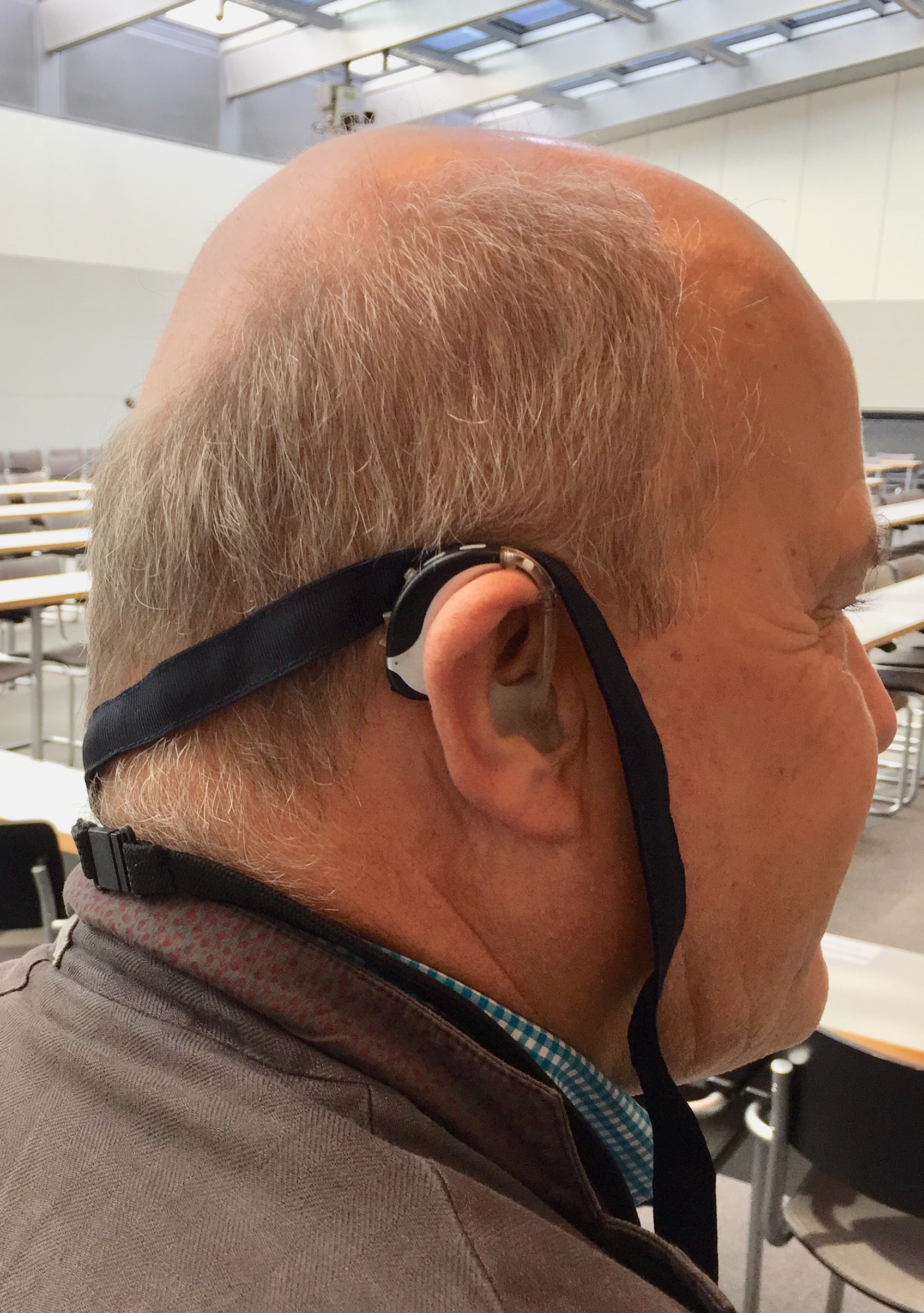
When a neckloop isn’t strong enough, or lacks the dynamic range output, hard of hearing users report they cannot hear or they can only hear by draping the neckloop over their ears (see photo below right). This is because we have let audio engineers – who do not understand hearing loss, hearing aids or neck-loops, make decisions for the type of assistive listening systems that are put in facilities.
Permit me to get on my soapbox: THERE IS NO EQUIVALENCY BETWEEN A HEARING LOOP and an FM/Infra-Red/FM-Loop system. Period. One system allows a user to walk in, sit just about anywhere and when unable to hear simply and discretely turn on a t-coil programmed for their hearing loss, on their personal device and, in some cases, use a smart app (on newer ReSound and Widex devices) to vary the M+T mix. The other system is not directly hearing aid compatible, a hassle for the user as well as the venue operator and user unfriendly.
Audiologists and hearing care providers who get this – and speak up and educate their clients – help foster a better world for every person with hearing loss. Consumers who get this, have found out that by speaking up they can change how hearing access is done.
If at First You Don’t Succeed,
Try, Try Again (or Email me)
Recently, I sent a letter to a reporter in response to her question how I have tackled a “No!” answer when I advocated for a hearing loop. While I don’t have all the answers, below is a list of my persuasion tactics.
I make a phone call or a pay a visit and explain why people with hearing loss (even if they use hearing aids and cochlear implants) have trouble hearing. I describe how hearing loss is more about the clarity and not the loudness. That hearing aids do not restore hearing to normal regardless of level of technology and that they generally don’t work in places with reverberation, background noise or over distances of 6-10 feet.I also explain how hearing loops work: A hearing loop sends the audio signal wirelessly from the facility’s microphone and sound system to those wearing t-coil compatible hearing aids, cochlear implants or a wireless headset (for those without hearing aids or without t-coil hearing aids).
It is my experience that most facility managers are receptive to this message and want to help. I can be more effective if a member or patron of the facility writes his or her story of not being able to hear or participate. It is just that the facility managers are often unaware of the difficulties people with hearing loss experience. During a visit I often play parts of sound demos in and out of hearing loops or a mother’s testimonials of a home loop installation. These sound demos can be eye – or should I say ear – opening?
Because hearing loops work so well, many testimonials include superlative language. Over the last few years I have collected responses from hearing loop users to let them do the talking. Other comments have been gathered here: loopwisconsin.com/testimonials.aspx
Advocating is made easier if I know that a facility will soon be undergoing a remodeling. The installation of the loop wire is usually easier (and less costly) when the carpeting is going to be replaced anyway. I have referred to the website from an experienced loop installer where hundreds of hearing loop installation photos in a variety of situations and types of flooring including terrazzo, tile, carpet and vinyl tiles to carpet are shown.
I explain that if a facility has a crawlspace and/or basement, loop wire installation can be done underneath the auditorium, sanctuary or meeting room to be looped. I make the facility aware that metal in the floor can affect the magnetic signal, and an in-situ hearing loop test is always required and refer to the Best Practices in Hearing Loop Procurement
If cost is a concern, I offer information as to how other venues have handled this expense or my blog on how to (find funding) to loop churches . For example, there are grant monies available for some venues (libraries and some houses of Worship). Many communities have a Community Foundation that may be willing to help fund a loop particularly if it improves access for a population with a disability. For example, in late 2008 the Oshkosh Area Community Foundation was helping to fund a remodel of the Oshkosh Convention Center. I made a couple of phone calls and sent a letter with information to the executive director. The result was they helped fund two hearing loops at the convention center about 2 weeks before the carpeting was to be laid down. The executive director believed me when I told her that having a hearing loop at the convention center would convince other venues to do the same. Oshkosh, WI now has over 50 hearing loops including its 100+ year old Grand Opera House, a funeral home, several court rooms, the City Council Room, several retirement communities, and the UW Alumni Welcome and Conference Center.
To increase attention to a need, I have found that a letter to the editor of a local newspaper can be of tremendous help. And the best part of such letters? They are free!
There is strength in numbers: If you are advocating for improved access ask a friend or family member or a local hearing professional to write a short letter of support as well.
The last resort would be to play the ADA card (Americans with Disability Act). The ADA mandates that facilities offer “in each assembly area where audible communication is integral to the use of the space, an assistive listening system (ALS) shall be provided.” Read up on the law and share the guidelines found here on page 36978 .
Public facilities are required to comply with the ADA law, and, in some states even non-profit facilities are required to install assistive technology. For example, the California Building Code requires houses of worship to always provide an ALS. Other states do not go that far, but may require a non-profit facility to provide an ALS if their space is rented to the public.
Finally, if a public facility is unwilling to comply with the law and provide an ALS, I refer people to the Department of Justice where they can tell their story and file a complaint. www.ada.gov/complaint/
Frankly, I have yet to see anyone I personally know resort to filing a complaint. Informing the venue – in writing – the intent of filing a complaint has convinced facilities to do the right thing. If this happens and a hearing loop gets installed, don’t forget to send a public “Thank You and Kudos for Installing a Hearing Loop” letter to the editor of your local newspaper. Such a public “shout out” and positive PR helps our cause. And who knows? This letter may even “nudge” other places to follow suit.
Hearing loop advocacy success is like an iceberg: While the first one or two installations may take several attempts, once loops find their way into a community they beget others. Why? Because hearing loops deliver. Hearing loops truly help people hear.



 Hearing loss is much more about clarity and loss of the ability to discern speech in background of noise than it is about audibility. What good is it to hear the voice when you cannot understand what it is saying? When people say “I didn’t hear what you said!” they heard you, they did not understand what was said; meaning the clarity was not there. Background noise is often the biggest issue: Some people can discern 50% of speech information (that’s when the brain fills in the rest of what it didn’t understand) when the speech is 3-5 dB louder than the background noise while others need 8-10 or even 15 dB difference between the speech and noise. This requires a hearing test called a SIN test (Speech-in-Noise test). How a person does on the SIN test cannot be predicted from the tone test. Demand this test from your hearing care provider. For more hearing aid buying information visit
 If at First You Don’t Succeed,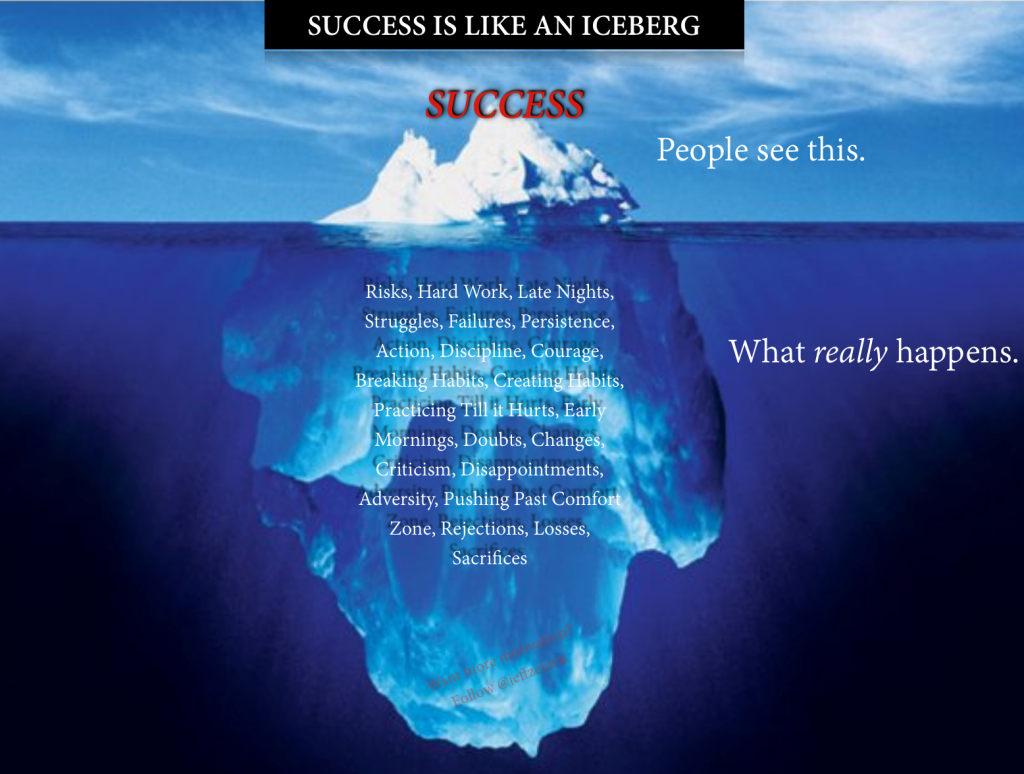
 Let's Loop Wisconsin
